



2200K or 2700K?
The colour temperature of a bulb is measured in Kelvin. We call 2200K extra warm white. It is similar to candlelight and has a slightly more yellow tone. If you prefer the colour of an incandescent bulb, still warm white but less yellow, we recommend 2700K. Both create a cosy atmosphere, but 2200K is warmer and more atmospheric, while 2700K is more neutral and clearer.
Which model do you choose?
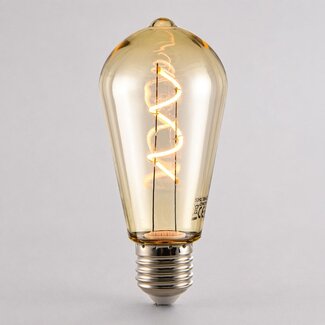
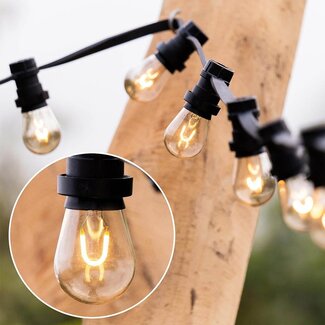
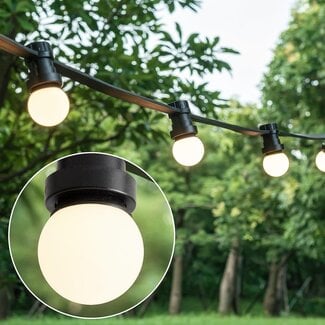
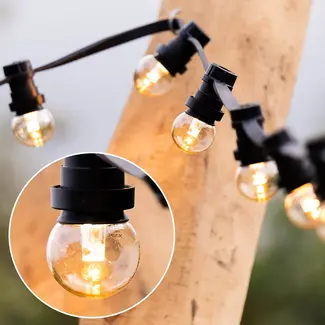
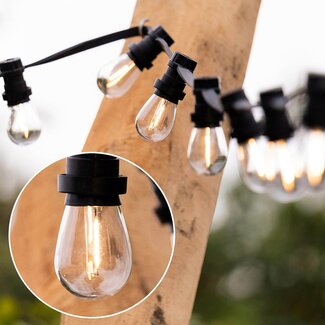
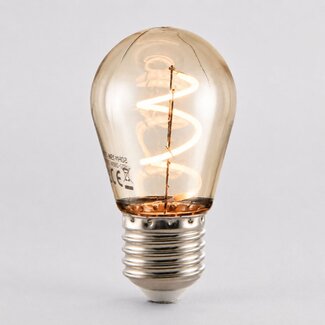
The 0.7W bulbs with a transparent shade are among our best-selling bulbs. From a distance, they are almost indistinguishable from a traditional incandescent bulb. There are also bulbs with the LEDs in the base and models with LEDs on short stalks, each giving a slightly different lighting effect. Looking for a visible spiral-shaped filament? Then take a look at the glass bulbs.
How many watts?
If you want soft ambient lighting, 0.7W or 1W bulbs are the best choice. A 1W bulb gives 60 lm and replaces an 8W incandescent bulb, while a 2W bulb gives 130 lm and replaces a 20W incandescent bulb. If you hang the festoon cable above a dining table where you want enough light to see your food clearly, 2W is the better choice.
Dimmable or non-dimmable
The advantage of dimmable bulbs is that you can adjust the brightness yourself: turn them up when you are eating, or dim them for a more atmospheric light. The bulbs are dimmable when used with our dimmers. For outdoor use, choose an IP44 dimmer set. There are also non-dimmable versions, which are cheaper if you do not plan to dim the lighting. For warm white, you can choose from various colour temperatures, from around 2000K, similar to candlelight, to 2650K, similar to the colour of an incandescent bulb.
Good to know
The bulbs have an E27 bulb fitting and an almost unbreakable polycarbonate shade. When screwing in the bulb, check that the sealing ring sits properly around it. If you want to dim the lighting, choose dimmable bulbs and an IP44 dimmer set suitable for outdoor use. These bulbs are also very suitable for use with our lanterns.


